Ebook BEGINNING COMPONENTS FOR ASP, by Richard Anderson Simon Robinson
Découvrez le BEGINNING COMPONENTS FOR ASP, By Richard Anderson Simon Robinson dans ce site basé sur le lien que nous avons fourni. Bien sûr, il restera certainement dans les données douces, mais en faisant cela peut vous soulager d'acquérir et d'utiliser cette publication. Cette publication intéressante est actuellement préoccupé par le type de publication simple à composer avec accrocheur objet d'un examen. Par ailleurs, la façon dont ils font la couverture est très sage. Il excelle idée de voir exactement comment cette publication apporte les visiteurs. Il verra également comment les téléspectateurs vont choisir ce livre à venir avec les temps d'arrêt while. Examinons aussi être l'une des personnes qui obtiennent cette publication.
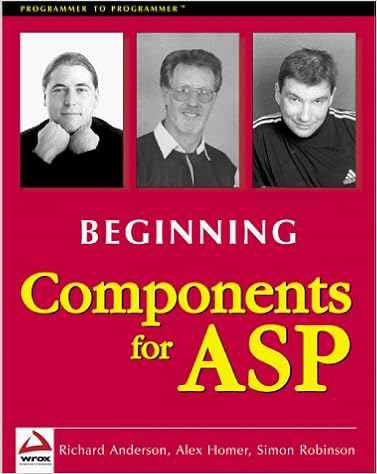
BEGINNING COMPONENTS FOR ASP, by Richard Anderson Simon Robinson

Ebook BEGINNING COMPONENTS FOR ASP, by Richard Anderson Simon Robinson
Gardez les progrès pour voir ce que vous pouvez faire plus. Vous avez encore aucune idée? Nous veillons à la fois que tout le monde a des méthodes différentes et aussi l'excellence en subissant leur vie. Néanmoins, l'objectif sera certainement souvent que le même. Beaucoup de volonté ont certainement besoin d'obtenir les discussions flambant neuf pour obtenir la reconnaissance. Néanmoins, en fournissant des détails, il limitera les ressources. En faisant cela pourrait utiliser le système d'impression fausse pour interagir.
Si vous voulez vraiment être plus intelligent, la lecture peut être parmi l'ensemble des moyens lots pour stimuler et réaliser. Beaucoup de gens qui, comme l'analyse aura beaucoup plus d'expertise et d'expériences. La lecture peut être un moyen d'obtenir les informations de l'économie des affaires, la politique nationale, la recherche scientifique, la fiction, les œuvres littéraires, la religion, ainsi que beaucoup d'autres. Comme l'un de la partie des classifications de publication, BEGINNING COMPONENTS FOR ASP, By Richard Anderson Simon Robinson finit toujours par être l'une de la publication le plus recherché. Beaucoup de gens sont à la recherche tout à fait pour cette publication. Cela implique que plusieurs aiment lire ce genre de publication.
Même ce livre est fait dans des formes douces de documents; vous pouvez prendre plaisir à l'analyse en obtenant le fichier dans votre ordinateur portable, gadget système informatique et périphérique. De nos jours, la lecture ne se termine pas être une activité typique de le faire par certaines personnes. Beaucoup de gens de nombreux endroits commencent à réviser constamment en début de matinée et aussi tous les loisirs. Cela prouve que les gens ont maintenant énorme curiosité et aussi l'esprit énorme à revoir. En outre, lorsque BEGINNING COMPONENTS FOR ASP, By Richard Anderson Simon Robinson est libéré, il devient un livre le plus besoin d'acquérir.
En voyant cette page web, vous avez déterminé que vous obtiendrez cette publication signifie rapidement, non? Oui, cela est vrai. Vous pouvez obtenir rapidement Guide ici. En voyant ce site, vous pouvez trouver le lien pour attacher à la bibliothèque et auteur de BEGINNING COMPONENTS FOR ASP, By Richard Anderson Simon Robinson Ainsi, vous pouvez obtenir est aussi facile que possible. Il implique en outre que vous serez certainement pas à court de ce livre. Néanmoins, ce site vous apporte également beaucoup plus collections ainsi que les classifications de livres de nombreuses ressources. Alors, restez simplement dans ce site chaque fois que vous rechercherez les livres.
Détails sur le produit
Broché: 845 pages
Editeur : Wrox; Édition : 01 (18 octobre 1999)
Collection : Programmer to programmer
Langue : Anglais
ISBN-10: 1861002882
ISBN-13: 978-1861002884
Dimensions du produit:
19 x 5,1 x 23,5 cm
Moyenne des commentaires client :
Soyez la première personne à écrire un commentaire sur cet article
Classement des meilleures ventes d'Amazon:
3.136.639 en Livres (Voir les 100 premiers en Livres)
It is really a Beginning Book although it doesn't really fit the title. Alot of folks will probably be scared away by the treatment that they put on ATL and OLEDB providers but i love it! Why? Becoz i've read Grime's Beginning ATL 3 COM and it was really painful reading but these guys made the concept seemed EASY!I like their walktruhs on RDS, ADSI and MSMQ, really neat. Something for me to get started on concepts which I am new to. Their treatment on MTS seemed like they pilfered the chapter from another wrox book - Professional VB MTS which covers the topic slightly in detail.Otherwise, this is truely a Beginning Book, but a caveat to VB and ASP only programmers as they will find this book too hard. Wish that Wrox come up with another book called Beginning COM ASP with ATL. Which will be really be great with the way they handled the topic.
There is a problem with some of the code examples in Chapter 7. There are some minor dicrepancy in the some of the earlier code. I went back and checked the code in 7 again and the download code will not work and the code described would have to be modified in order to work. I consider this an egregious error on the part of the publisher and authors, especially since they've had more than 2 years to correct the mistake. I did find some of the information in some of the other chapters useful, but when sections are this bad, I begin to question everything else. I also examined wrox web site and found it humourous that the only errata given for a 2 year old book is only 8 days old.
Beginning Components for ASP.A book review by Michael Gokey (yes, I know sounds like I'm in 4th grade)Wow, I love the Beginning Components for ASP (Active Server Pages) book. Some great programmers, Richard Anderson, Simon Robinson, and Alex Homer wrote it. Of course, it was published by Wrox. These guys ROCK!I need to say, "What a well-used book". I started to say, well written, but who cares if it was well written. What really matters before you buy the book is if you will get some good use out if it. If, by use you mean, you will have dog-eared pages, highlights out the kazoo, and sticky-notes in all the margins, then the answer is a resounding YES! By the way, I do think it was written well, but I am not an English major. I am a working ASP programmer, trying to learn COM for ASP.If you have Visual Basic (5 or later) running, and know a little bit about it, and are maybe a little bit past the beginning stage of ASP (2 or later) programming, then this book would really help you out, as it did me.The first part of the book was written for an ASP programmer, just starting to use components. It answers those all-important beginning questions like: What is a component? In addition, why do we need them? Moreover, what do they do?Part I The first part of the book has nine chapters, deals with everything the nitty gritty details a starting COM programmer needs to know. It begins with "What is COM", and it's interfaces, and the host environments. It explains that most ASP sites do real work and are not just siting around looking pretty; they deal with data through ADO and COM. This book has prepared to build your first component in just a short while. It explains everything you need to have and do. I was so happy to get my first component working.This book goes into the basics of Microsoft Transaction Server (MTS). This book explains better than the big MTS book I have, and never could quite make it through. It explains in depth about transactions, scalability, and resources. I work in a small shop, but try to look hard at large NT/IIS/ASP sites, that I will be working for some day, and try to learn from them. Before going into the MTS stuff, it really goings into explaining n-tier in laymen's terms. I am also starting to use the MS Message Queue. How dumb could I have been? A year and half ago, I thought it was another way of doing email, or SMTP stuff, so I dismissed it. That was a bad move on my part. What I now know is that it is the systems are talking to each other. "Yes, I got that message, did you get mine about the transaction failing?" I know I've simplified it and it's not exactly like that, but you've only got a few minutes for me to tell you why, if you are like me, you should look at this stuff. The book also later explains ADSI, which I still do not need, but at least I now know more about it.Part II The second part of the book is for Visual C++ people, you know, those real geeks, which really understand the deep levels of code, and make stuff harder than they need to. I thought I would not get much out of it, but I was dead wrong. There are five in-depth chapters in the second part of the book, which break all the rules you just learned in the first part, well not really. I still use the first part since that is what really suited me.I really learned a lot more about MTS, and the Active Template library, and more about programming logic, and the MS OLE DB templates. I also learned more about VC++. You know, the stuff that you put off, and say that you've been meaning too, just haven't gotten around to it, been very busy just trying to keep up with my little world.The book also has a great two-chapter "case study" on XML. It uses ASP, components, and XML, to "solve" a document management problem. That is why we are paid the big bucks to solve problems, using whatever tools we need.The last part of this book, as in all great Wrox computer books, has a couple of appendices. The ASP object model, and the ADO object model, and library references for the MTS, and Message Queue Objects. The last one was about COM and the registry.My final comments are, that out of the at least five other basic COM books I have really examined, this is the best. I really read it, did the examples, and learned from it. Some of the books I look at, I think, "Yes, I could use this, or learn from it", but I never do. The book needs to pull you in, like Beginning Components for ASP does. The two main authors, Richard Anderson and Simon Robinson, each did a great job on their sections, and Alex Homer, helped tie it all together and smooth it out. I generally like most books of which Alex has part. I think you will like and use this book as much as I did.
If there is one thing that I hate about computer books is that a great deal of effort is spent at the front of the book thanking the cat, the dog, the parents, the brothers and sisters, the goldfish for all the help and inspiration. Then they move on to the publisher, the agent, the technical editors etc.etc.Same with this book. So I read the boring introduction. The usual story. I move on to the first chapter. Uninspired but interesting. First stupid example out the chute and it doesn't work.And you know why. I will tell you why because all those people in the intro didn't do their JOB of checking the examples. They become buddy-buddy with the authors and out goes the critical and detached supervision that is needed.I have a million DLLs, OCXs, ActiveXs on my PC that no one else has. But if I write a book, I MUST write it on a PC that has none of that. I can ASSUME nothing. Absolutely nothing.It took me two days of hard yakka, reading the entire MS Scripting Technologies site to figure out what those three stooges forgot to mention. A great many things that they had already preconfigured on their PCs, but did bother telling the rest of us.The technical editors being buddy-buddy with the the authors just get the heads-up on what they need to install. Oh Yes, everything works fine. Stuff the reader. Who cares about the reader ?Well the reader is the stupid schmuck that goes out and buys your tripe. Think about that next time you publish a book.If I could give this book a minus 5 stars I would.
BEGINNING COMPONENTS FOR ASP, by Richard Anderson Simon Robinson PDF
BEGINNING COMPONENTS FOR ASP, by Richard Anderson Simon Robinson EPub
BEGINNING COMPONENTS FOR ASP, by Richard Anderson Simon Robinson Doc
BEGINNING COMPONENTS FOR ASP, by Richard Anderson Simon Robinson iBooks
BEGINNING COMPONENTS FOR ASP, by Richard Anderson Simon Robinson rtf
BEGINNING COMPONENTS FOR ASP, by Richard Anderson Simon Robinson Mobipocket
BEGINNING COMPONENTS FOR ASP, by Richard Anderson Simon Robinson Kindle
Post a Comment